
Venmo and Cash App scams exploded as peer-to-peer payments replaced cash for marketplace sales, rent deposits, and even utility bills. Unlike credit cards, P2P transfers are often instant and irreversible — which is exactly why criminals prefer them.
Daily editor note (Aug 27, 2026): We added a quick reminder based on the fraud patterns reported to us this week. See our latest alerts.
Daily editor note (Aug 17, 2026): We added a quick reminder based on the fraud patterns reported to us this week. See our latest alerts.
Daily editor note (Aug 7, 2026): We added a quick reminder based on the fraud patterns reported to us this week. See our latest alerts.
Daily editor note (Jul 28, 2026): We added a quick reminder based on the fraud patterns reported to us this week. See our latest alerts.
Daily editor note (Jul 18, 2026): We added a quick reminder based on the fraud patterns reported to us this week. See our latest alerts.
Daily editor note (Jul 8, 2026): We added a quick reminder based on the fraud patterns reported to us this week. See our latest alerts.
How Venmo and Cash App Scams Work
Scammers exploit the trust users place in familiar app interfaces. Common patterns include fake payment screenshots, “accidental” transfers demanding refunds, and impersonation of friends or customer support.
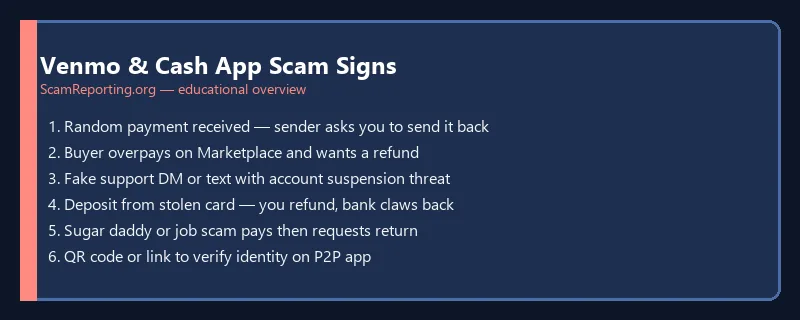
- Fake buyer overpayment: A marketplace buyer “accidentally” sends too much and asks you to refund the difference via another method.
- Screenshot fraud: Criminals send edited images showing a completed payment that never cleared.
- Accidental transfer scam: You receive money from a stranger who pleads for an urgent refund — the original transfer was from a stolen card and will be reversed.
- Impersonation texts: Messages claim your account is locked and link to a phishing page stealing login credentials.
- Rental and ticket fraud: Scammers demand deposits via Venmo or Cash App, then disappear.
- Romance and employment scams: Victims are coached to send P2P payments instead of traceable bank wires.
Venmo and Cash App Red Flags
- Any request to refund money to a different account or payment method
- Pressure to complete a transaction outside Facebook Marketplace, eBay, or OfferUp protections
- Payment “proof” that is only a screenshot — never a verified in-app notification
- Messages about account suspension with a link to log in
- Strangers sending money first, then demanding it back urgently
- Requests for your login, PIN, or verification codes
What to Do If You Sent Money
- Stop sending more — scammers often request a second “fee” payment.
- Screenshot everything — usernames, transaction IDs, and chat history.
- Report inside the app — Venmo and Cash App have in-app fraud reporting tools.
- Contact your bank if the transfer was funded from a linked debit card.
- File with the FTC at ReportFraud.ftc.gov and our report form.
- Read realistic recovery options — P2P refunds are limited but not always zero.
How to Pay Safely on P2P Apps
- Use P2P only with people you know and trust — treat it like cash.
- For marketplace sales, insist on in-person cash or platform-protected checkout.
- Verify payments in the app itself, not via screenshots.
- Enable PIN or biometric locks on Venmo and Cash App.
- Learn related schemes: Zelle refund trick and gift card payment fraud.
Frequently Asked Questions
Can Venmo reverse a payment to a scammer?
Venmo generally treats completed payments as final. Report immediately — in some cases linked bank chargebacks may apply if funded by debit.
Is Cash App safer than Venmo?
Neither is designed for buyer protection on stranger transactions. Safety depends on how you use them, not the brand.
Why do scammers ask for a refund to a different account?
The original payment is often fraudulent or will bounce. Your “refund” sends real money from your balance to the criminal.
Think you were targeted? Get step-by-step help or report the scam.
Was this guide helpful?
Your feedback helps us prioritize updates. We do not collect any personal data.
Thanks — recorded.