
The gift card scam is one of the most common payment fraud tactics in the United States. Scammers impersonate the IRS, tech support, employers, romantic partners, or utility companies — then insist you pay with store gift cards instead of a bank transfer.
Daily editor note (Sep 5, 2026): We added a quick reminder based on the fraud patterns reported to us this week. See our latest alerts.
Daily editor note (Aug 26, 2026): We added a quick reminder based on the fraud patterns reported to us this week. See our latest alerts.
Daily editor note (Aug 16, 2026): We added a quick reminder based on the fraud patterns reported to us this week. See our latest alerts.
Daily editor note (Jul 27, 2026): We added a quick reminder based on the fraud patterns reported to us this week. See our latest alerts.
Daily editor note (Jul 17, 2026): We added a quick reminder based on the fraud patterns reported to us this week. See our latest alerts.
Daily editor note (Jul 7, 2026): We added a quick reminder based on the fraud patterns reported to us this week. See our latest alerts.
Why Scammers Demand Gift Cards
Gift cards act like untraceable cash. Once you read the numbers to a criminal, the balance can be drained in minutes and chargebacks are nearly impossible. Legitimate businesses and government agencies never accept payment via Apple, Google Play, Amazon, Target, or Visa gift cards.
Common Gift Card Scam Scripts
- IRS or tax debt: "Pay your balance with gift cards to avoid arrest."
- Tech support: "Purchase cards to fix your computer remotely."
- Romance scam: "Buy cards so I can buy a plane ticket to visit you."
- Utility shutoff: "Pay your overdue electric bill with cards today."
- Boss impersonation: "Buy gift cards for a client — I’ll reimburse you."
- Bail or hospital: "Your relative is in jail — pay bail with cards now."
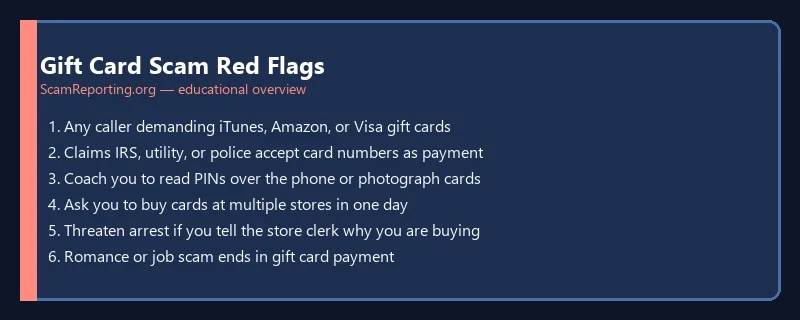
Gift Card Scam Red Flags
- Any request to pay taxes, fines, bills, or fees with gift cards
- Pressure to stay on the phone while you purchase cards
- Instructions to scratch codes and read numbers over the phone or by text
- Requests to photograph card backs and send images
- Claims that gift cards are a "government payment system"
- Secrecy — "don’t tell the store clerk why you’re buying cards"
What to Do If You Already Bought Gift Cards
- Stop immediately — do not send more card numbers or PINs.
- Call the gift card issuer (number on the card packaging) and report fraud — some balances can be frozen if caught early.
- Keep receipts and card packaging as evidence.
- Contact your bank if you used a debit card to purchase the gift cards.
- Report to the FTC at ReportFraud.ftc.gov and file on our report a scam form.
- File a police report — required by some retailers and insurers.
How to Protect Yourself
- Treat gift cards as cash for friends and family only — never for strangers or "official" payments.
- Hang up on anyone demanding card payment; verify through official websites.
- Warn elderly relatives — grandparent scams and Medicare impersonation often end in gift card purchases. See our Medicare phone scam guide.
- Learn related schemes: fake government refund scams and tech support pop-ups.
Frequently Asked Questions
Can I get a refund on gift cards sent to a scammer?
Recovery is difficult but not always zero. Report immediately to the card issuer and law enforcement. Speed matters.
Why do stores sell high-value gift cards to scam victims?
Retailers train staff to spot fraud, but scammers coach victims on what to say at checkout. Tell clerks if you feel pressured.
Are cryptocurrency and wire transfers the same risk?
Yes — scammers switch between gift cards, Zelle, wire, and crypto. See our Zelle refund trick guide for bank impersonation variants.
Think you were targeted? Get step-by-step help or report the scam.
Last reviewed: June 2026. Educational content only — not legal advice.
Was this guide helpful?
Your feedback helps us prioritize updates. We do not collect any personal data.
Thanks — recorded.