
The Zelle scam refund trick is one of the fastest-growing bank impersonation schemes in 2026. Victims receive texts or calls claiming a fraudulent Zelle payment was sent from their account — then are coached to “reverse” the transaction by sending money to themselves, which actually goes to the scammer.
Daily editor note (Aug 19, 2026): We added a quick reminder based on the fraud patterns reported to us this week. See our latest alerts.
Daily editor note (Aug 9, 2026): We added a quick reminder based on the fraud patterns reported to us this week. See our latest alerts.
Daily editor note (Jul 30, 2026): We added a quick reminder based on the fraud patterns reported to us this week. See our latest alerts.
Daily editor note (Jul 20, 2026): We added a quick reminder based on the fraud patterns reported to us this week. See our latest alerts.
Daily editor note (Jul 10, 2026): We added a quick reminder based on the fraud patterns reported to us this week. See our latest alerts.
After you report: Document bank fraud through our report form and see HowToReport.org consumer fraud filing for state AG and FTC paths.
July 2026 update: The FTC reports these scripts increasingly overlap with fake government recovery calls and toll-road smishing — same urgency tactics, different cover story. If a “bank fraud agent” also texts a photo ID, hang up.
What Is the Zelle Refund Scam?
Fraudsters impersonate your bank’s fraud department via spoofed phone numbers and SMS alerts. They create urgency around unauthorized Zelle transfers and walk you through steps that look like a refund but instead authorize a new payment to the criminal’s account.
Because Zelle transfers are typically instant and irreversible, victims often lose funds within minutes.
How the Scam Works Step by Step
- Spoofed alert: Text or call claims suspicious Zelle activity on your account.
- Fake verification: Scammer asks you to confirm recent transactions or read back codes.
- Refund narrative: You are told to Zelle money to your own email/phone to “reverse” the fraud.
- Account switch: The destination is actually linked to the scammer’s bank account.
- Pressure: Urgent language prevents you from calling your bank on the official number.
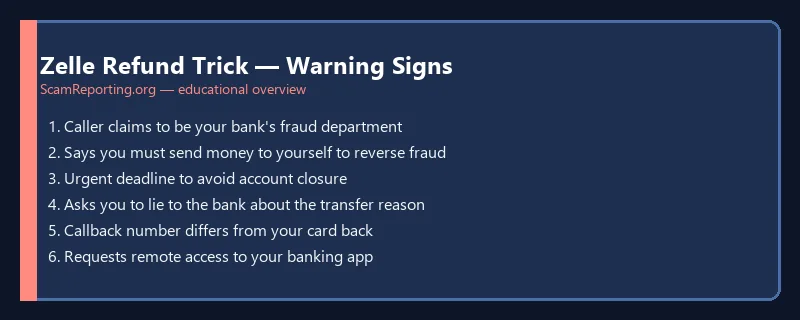
Zelle Scam Red Flags
- Unsolicited fraud alerts asking you to send money — even to yourself
- Caller refuses to let you hang up and dial your bank directly
- Requests for one-time passcodes, PINs, or remote access to your phone
- Instructions to move funds to “a safe account” or “government holding account”
- Poor grammar in texts combined with realistic-looking sender IDs
- Pressure to act within minutes to avoid account closure
Zelle vs. Credit Card: Why Recovery Is Hard
Credit card fraud often allows chargebacks. Zelle is a peer-to-peer payment network designed for sending cash to people you trust. Treat Zelle like cash — if you authorize a transfer, recovery options are limited.
Your real bank will never ask you to Zelle money to reverse fraud.
What to Do If You Are Targeted
- Hang up and call the number on the back of your debit card or bank website
- Do not send Zelle payments to unknown recipients or “yourself” via third-party instructions
- Change passwords and enable multi-factor authentication on banking apps
- Report to your bank immediately — timing matters
- File complaints with FBI IC3 and the FTC at ReportFraud.ftc.gov
- Submit details on our scam report form
How to Protect Yourself Long Term
- Enable transaction alerts for all Zelle and debit activity
- Use Zelle only with people you know and have verified in person
- Never share OTP codes — banks use them to confirm YOU are authorizing transfers
- Learn about investment grooming scams that also push P2P payments
- Review our bank scam archive for similar schemes
Frequently Asked Questions
Can banks reverse a Zelle scam payment?
Sometimes, if reported within minutes and the receiving account has not been drained. There is no guarantee. Act immediately.
Is receiving a random Zelle payment a scam?
It can be an “accidental transfer” prelude to a social engineering call. Do not return money via Zelle — contact your bank.
Are Zelle scams the same as phishing?
They often combine phishing texts with voice social engineering. See our phishing guide for broader context.
Encountered this scam? Report it here or read what to do after being scammed.
Last reviewed: July 2026. Sources: CFPB peer-to-peer payment guidance, FTC imposter scam alerts.
Was this guide helpful?
Your feedback helps us prioritize updates. We do not collect any personal data.
Thanks — recorded.