
BEC protection hub: Primary guide for wire fraud and executive impersonation. Deep dive: how BEC works · employment scam overlap.
Related BEC Guides
What Is Business Email Compromise?
Business email compromise (BEC) is a targeted fraud scheme where criminals impersonate executives, vendors, or colleagues to trick employees into wiring money, changing payment details, or sharing sensitive data. Unlike mass phishing, BEC is highly personalized and often uses compromised or spoofed email accounts.
Warning Signs
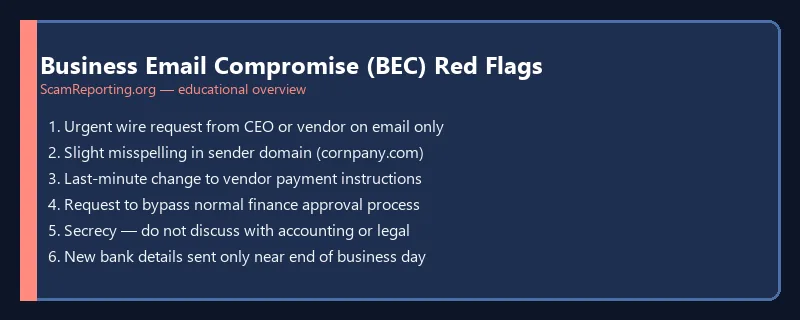
- Urgent wire-transfer requests from a CEO, CFO, or attorney
- Last-minute changes to vendor bank account details
- Slightly altered email domains (e.g., company-inc.com vs company.com)
- Secrecy pressure — “do not discuss with finance” or “confidential acquisition”
- Requests outside normal approval workflows
- Invoice duplicates with new payment instructions
Common BEC Schemes
- CEO fraud — fake executive emails demanding immediate transfers
- Invoice redirection — hacked vendor accounts sending fake invoices
- Vendor impersonation — attackers pose as suppliers updating wire details
- Payroll diversion — HR receives fake requests to change direct deposit
What to Do
- Verify out-of-band — call a known number; never use contact details in the suspicious email
- Enforce dual approval for all wire transfers and vendor changes
- Enable DMARC, DKIM, and SPF on your domain
- Train staff on BEC red flags quarterly
- Report incidents via our report form and to the FBI IC3
Related Resources
- Full BEC guide (detailed)
- Advance-fee fraud hub
- Phishing & smishing warning signs
- Get help after a scam
Frequently Asked Questions
How is BEC different from phishing?
Phishing casts a wide net with generic lures. BEC targets specific employees with believable, context-rich messages that mimic real business processes.
Can small businesses be targeted?
Yes. Small and mid-size businesses are frequent targets because they often lack formal payment verification procedures.
What is the fastest way to verify a wire request?
Call the requester using a phone number from your internal directory — not the number or link in the email.
Should we pay if we already sent money?
Contact your bank immediately to attempt a recall, file an IC3 report, and see our recovery resources.
Was this guide helpful?
Your feedback helps us prioritize updates. We do not collect any personal data.
Thanks — recorded.