
Quick answer: To report identity theft, file an official report at IdentityTheft.gov (the FTC’s recovery system), place a free fraud alert or credit freeze with the three credit bureaus, and — if a specific account or crime is involved — file a police report and notify the affected company. Do this as soon as you notice unauthorized activity.
Free checks: Scamil Email Checker · Scam Checker · Scammer Lookup
Learning how to report identity theft quickly limits the damage a thief can do with your name, Social Security number, or accounts. This guide walks through every place you may need to report — the FTC, the three credit bureaus, the Social Security Administration, the IRS, and local police — plus the order that saves you the most time. If a scammer already has your details, start with our SSN exposure checklist and then work through the reporting steps below.
Where to report identity theft (official)
- FTC — IdentityTheft.gov — identitytheft.gov · 877-438-4338
- Equifax — equifax.com/credit-freeze · 888-298-0045
- Experian — experian.com/help/credit-freeze · 888-397-3742
- TransUnion — transunion.com/credit-freeze · 800-916-8800
- IRS Identity Theft — irs.gov/identity-theft-central · 800-908-4490
- SSA fraud (OIG) — oig.ssa.gov · 800-269-0271
- Free credit reports — annualcreditreport.com · 877-322-8228
Official links open in a new tab. ScamReporting.org is an independent resource and is not affiliated with these agencies.
Where to Report Identity Theft (Official Channels)
There is no single button that fixes identity theft. Recovery usually means reporting to more than one organization. The core channels are:
- FTC — IdentityTheft.gov: the federal starting point. It creates an FTC Identity Theft Report and a personalized recovery plan.
- Credit bureaus (Equifax, Experian, TransUnion): place a fraud alert or credit freeze so new accounts cannot be opened in your name.
- The company where fraud happened: the bank, card issuer, or retailer whose account was misused.
- Local police: for a police report when a creditor requires one or a crime (like stolen mail or a break-in) is involved.
- Specialized agencies: the Social Security Administration, IRS, or your state DMV for the specific ID that was misused.
Step 1: File an FTC Report at IdentityTheft.gov
Start at IdentityTheft.gov. You answer questions about what happened, and the site generates two things: an FTC Identity Theft Report (an official affidavit) and a step-by-step recovery plan tailored to your situation. Keep a copy of the report — banks and credit bureaus accept it as proof when removing fraudulent accounts. This is free and does not require you to have caught the thief.
Step 2: Add a Fraud Alert or Freeze Your Credit
Contact any one of the three national credit bureaus and ask for a fraud alert — that bureau must tell the other two. A fraud alert is free and warns lenders to verify your identity before opening credit. For stronger protection, place a credit freeze at each bureau, which blocks new credit entirely until you lift it. Our full walkthrough covers the exact steps and links: how to freeze your credit.
Step 3: Report to the Company Where Fraud Occurred
Call the fraud department of each business where an account was opened or misused. Reference your FTC Identity Theft Report, ask them to close or freeze the account, and request written confirmation that you are not liable for the fraudulent charges. If money left your bank, act fast — see can you get money back after a scam for recovery odds by payment method.
How to Report Identity Theft to Specific Agencies
Report identity theft to the credit bureaus
Beyond a fraud alert, you can dispute fraudulent accounts directly with Equifax, Experian, and TransUnion. Send your FTC report and ask them to block the fraudulent information from your credit file. Review each report for accounts you do not recognize.
Report identity theft to the Social Security Administration
The SSA does not resolve identity theft directly — it directs victims to the FTC at IdentityTheft.gov. Report Social Security–related fraud or scams (such as SSN misuse) to the SSA Office of the Inspector General at oig.ssa.gov or 800-269-0271, and review your Social Security Statement in your my Social Security account for unfamiliar earnings. The SSA issues a new number only in rare cases.
Report identity theft to the IRS (tax fraud)
If someone filed a tax return using your SSN, or the IRS notifies you of a suspicious return, file IRS Form 14039 (Identity Theft Affidavit) and report at IRS Identity Theft Central. You may be issued an Identity Protection PIN for future filings. Tax-season impersonation often starts with a call — see IRS phone scam red flags.
Report identity theft to the police
File a report with your local police department when a creditor requests one, your identity is tied to a crime, or physical documents were stolen. Bring your FTC Identity Theft Report, a government ID, proof of address, and any evidence of the fraud. Ask for a copy of the police report and the report number.
Identity Theft Warning Signs
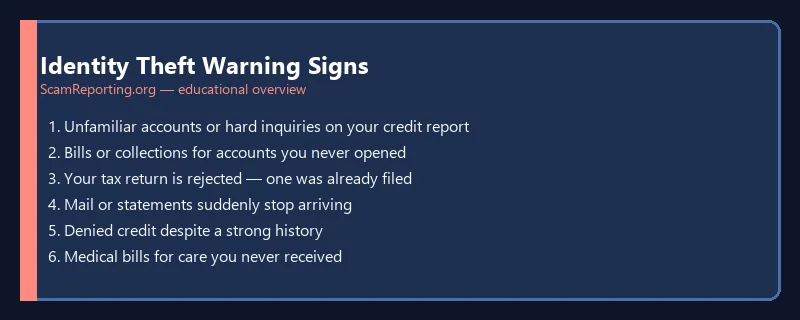
- Unfamiliar accounts, hard inquiries, or addresses on your credit report
- Bills or debt-collection calls for accounts you never opened
- Your tax return is rejected because one was already filed
- Missing mail, or statements that stop arriving
- Denied credit despite a good history
- Notices that your information appeared in a data breach
- Medical bills or insurance claims for care you never received
What to Do After You Report Identity Theft
- Keep records. Save your FTC report, police report number, and every letter or confirmation.
- Change passwords and enable two-factor authentication on email, banking, and shopping accounts.
- Monitor your credit for at least 12 months. You are entitled to free reports at AnnualCreditReport.com.
- Dispute in writing and follow up — resolution can take several billing cycles.
- Report the underlying scam on our report a scam form so the tactic is documented for others.
Types of Identity Theft (and Where Each Is Reported)
“Identity theft” covers several distinct crimes, and where you report can depend on which one you are facing:
- Financial identity theft — new loans or cards opened in your name. Report to the bureaus and each creditor.
- Tax identity theft — a fraudulent return filed for your refund. Report to the IRS with Form 14039.
- Employment or SSN misuse — someone works under your Social Security number. Report to the SSA and check your earnings record.
- Medical identity theft — care or prescriptions billed in your name. Report to your insurer and providers.
- Government benefits fraud — unemployment or benefits claimed with your identity. Report to the issuing state agency.
- Criminal identity theft — your name given to police by someone else. This usually requires a police report and legal follow-up.
Many victims face more than one type at once, which is why the FTC recovery plan at IdentityTheft.gov is a useful hub — it tells you which agencies apply to your case.
How Long Do You Have to Report Identity Theft?
There is no deadline to report identity theft, and you should report as soon as you notice it — the faster you act, the easier disputes are. That said, some protections are time-sensitive: credit-billing disputes generally have a 60-day window from the statement date, and prompt reporting strengthens your zero-liability protection on cards. Reporting late does not waive your rights, but it can make proving the fraud harder. Keep dated records of when you discovered each problem.
Identity Theft Recovery Timeline
Recovery is a process, not a single event. A realistic sequence looks like this:
- Day 1: file at IdentityTheft.gov, place a fraud alert or freeze, and call affected companies.
- Week 1: submit written disputes with your FTC report attached; request account closures in writing.
- Weeks 2–6: bureaus and creditors investigate; fraudulent items are blocked or removed.
- Months 2–12: monitor credit reports, watch for new fraud, and follow up on anything unresolved.
Complex cases — especially criminal or medical identity theft — can take longer and may need legal help.
How to Prevent Future Identity Theft
Once you have reported the theft, reduce the odds of it happening again. Freeze your credit when you are not actively applying for it, shred documents with account numbers, and never share your SSN because an unsolicited caller demands it. Paste suspicious emails into the Scamil Email Checker and text messages into the Scam Checker before you click. Enable transaction alerts on every account, use a unique password and two-factor authentication on your email (the master key to your other logins), and check your free reports at AnnualCreditReport.com on a rotating schedule. If you lost money or shared sensitive data, our get help after a scam page lists realistic next steps.
Frequently Asked Questions
Where do I report identity theft first?
Start at IdentityTheft.gov to create your FTC Identity Theft Report, then place a fraud alert or credit freeze with the bureaus. Add a police report if a creditor asks for one.
Is reporting identity theft to the FTC free?
Yes. IdentityTheft.gov is a free government service, and fraud alerts and credit freezes are free by law.
Do I need a police report for identity theft?
Not always. You need one when a company or creditor requires it, when your identity is linked to a crime, or when documents were physically stolen.
How do I report identity theft to the credit bureaus?
Contact Equifax, Experian, or TransUnion to place a fraud alert (one notifies the others) or a freeze at each, then dispute fraudulent accounts with your FTC report attached.
How long does identity theft recovery take?
Simple cases can resolve in weeks; complex fraud across multiple accounts can take months. Keeping detailed records speeds up disputes.
What if my SSN was used to file taxes?
File IRS Form 14039 and report at IRS Identity Theft Central. You may receive an Identity Protection PIN for future returns.
Last reviewed: July 2026. ScamReporting.org is an independent educational resource — not a government agency, law enforcement, bank, credit bureau, or legal/financial advisor. For recovery or legal questions you may want to consult a licensed professional.