
Quick answer: To freeze your credit, contact each of the three credit bureaus — Equifax, Experian, and TransUnion — and request a security freeze online, by phone, or by mail. It is free, blocks new lenders from seeing your report, and stops most new-account identity theft. You must freeze all three separately, and you can lift a freeze anytime.
Free checks: Scamil Email Checker · Scam Checker · Scammer Lookup
A credit freeze is one of the strongest, cheapest defenses against identity theft — and knowing how to freeze your credit takes about 15 minutes across the three bureaus. This guide explains what a freeze does, how to place one at each agency, how to temporarily lift it when you need credit, and how a freeze differs from a fraud alert or credit lock. If your information was already exposed, pair this with our how to report identity theft guide.
Official credit freeze contacts (free)
- Equifax — equifax.com/credit-freeze · 888-298-0045
- Experian — experian.com/help/credit-freeze · 888-397-3742
- TransUnion — transunion.com/credit-freeze · 800-916-8800
Official links open in a new tab. ScamReporting.org is an independent resource and is not affiliated with these agencies.
What a Credit Freeze Does
A security freeze restricts access to your credit report. Because most lenders will not open an account without checking your report, a freeze blocks criminals from taking out loans or cards in your name. A freeze does not affect your credit score, does not stop you from using existing cards, and does not block your own access to your report. Since 2018, freezing and unfreezing are free at all three bureaus under federal law.
How to Freeze Your Credit at All 3 Bureaus
You must place a freeze with each bureau individually. Have your name, address, Social Security number, and date of birth ready. Each bureau gives you a PIN or account login you will use to lift the freeze later — store it safely.
- Equifax: freeze online through your myEquifax account, by phone, or by mail.
- Experian: freeze through Experian’s security freeze center online, by phone, or by mail.
- TransUnion: freeze through your TransUnion service center online, by phone, or by mail.
Always start from a bureau URL you type yourself — not a link in an email or text. Scammers run look-alike “credit freeze” sites; if in doubt, paste the message into the Scam Checker first.
How to Freeze Your Credit for Free
Freezing is free at Equifax, Experian, and TransUnion — you should never pay for it. Paid “credit protection” products are optional add-ons, not the freeze itself. There are two smaller bureaus some lenders use (Innovis and the NCTUE); freezing those is also free and optional for extra coverage.
How to Temporarily Lift (Thaw) a Freeze
When you apply for a loan, card, apartment, or job that checks credit, temporarily lift the freeze at the bureau the lender uses. Log in or call, choose a lift period or a specific creditor, and the freeze re-applies automatically afterward. Lifts are also free and usually take effect within minutes online.
Credit Freeze vs. Fraud Alert vs. Credit Lock
| Tool | What it does | Cost |
|---|---|---|
| Credit freeze | Blocks new credit access until lifted | Free |
| Fraud alert | Asks lenders to verify identity (1 year, renewable) | Free |
| Credit lock | Similar to a freeze via an app; terms vary | May cost money |
A freeze is the strongest free option. A fraud alert is lighter and only requires contacting one bureau. Victims of identity theft can get an extended fraud alert — see how to report identity theft.
When to Freeze Your Credit
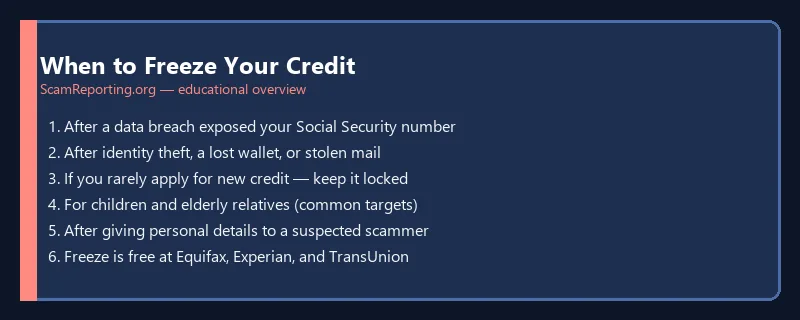
- After a data breach exposed your Social Security number
- After identity theft, a lost wallet, or stolen mail
- If you rarely apply for new credit and want it locked by default
- For children and elderly relatives who are common identity-theft targets
- After you gave personal details to a suspected scammer — see our SSN checklist
How to Freeze Your Credit at Each Bureau (Details)
Freeze your credit at Equifax
Create or sign in to a myEquifax account to place, temporarily lift, or permanently remove a freeze online. You can also call Equifax’s automated freeze line or mail a written request with copies of your ID and proof of address. Online changes are usually immediate.
Freeze your credit at Experian
Use Experian’s security freeze center to add a freeze with your personal details. Experian issues a PIN you will need to lift the freeze; store it with your other freeze credentials. Phone and mail options are available if you prefer not to freeze online.
Freeze your credit at TransUnion
Open a TransUnion service center account to manage your freeze online, or freeze by phone or mail. As with the others, keep the login or PIN somewhere safe so you can thaw quickly when you apply for credit.
Because a link in an email or text could be a look-alike site, always type the bureau’s address yourself. If you received a “freeze your credit now” message, check it with the Scam Checker before acting.
How Long Does a Credit Freeze Last?
A security freeze stays in place until you remove it — it does not expire. That is different from a fraud alert, which lasts one year (or seven years for confirmed identity-theft victims) and then must be renewed. Because a freeze is permanent until lifted, it is well suited to people who apply for credit rarely and want protection by default.
Should You Freeze Your Credit? Pros and Cons
Pros: it is free, it does not affect your credit score, it is one of the most effective blocks against new-account identity theft, and you control it entirely. Cons: you must remember to thaw it before applying for credit, you have to manage three (or more) bureaus separately, and it does nothing to stop fraud on accounts you already hold. For most people the trade-off favors freezing — the minor inconvenience of thawing is small next to the protection it provides.
Credit Freeze vs. Credit Monitoring
A freeze is preventive — it blocks new credit from being opened. Credit monitoring is detective — it alerts you after something changes on your report. They work best together: freeze to prevent, monitor to catch anything that slips through (such as misuse of existing accounts). You do not need to pay for monitoring to freeze; free annual reports and bank alerts cover the basics.
Freezing a Child’s or Elderly Relative’s Credit
Children are prime identity-theft targets because their clean credit files can go unnoticed for years. Parents and legal guardians can request a free freeze on a minor’s credit file at each bureau by submitting proof of guardianship and the child’s identity documents by mail. The same applies to elderly relatives you have authority to act for, and to the file of a deceased family member to prevent “ghosting” fraud. Because these requests usually go by mail with copies of sensitive documents, send them through a trusted method and keep copies of everything.
Common Credit Freeze Mistakes to Avoid
- Freezing only one bureau. Lenders may pull from any of the three — freeze all of them.
- Losing your PIN or login. You need it to thaw; store credentials securely.
- Paying for a “freeze” service. The freeze itself is always free by law.
- Using a link from a text or email. Type the bureau address yourself to avoid look-alike sites.
- Forgetting to thaw before applying. Lift the freeze first, or your application may be declined.
What a Freeze Does Not Protect Against
A freeze stops most new-account fraud, but it does not stop misuse of accounts you already have, tax-refund fraud, medical identity theft, or scams where you are tricked into sending money yourself. Keep monitoring statements, and if you are pushed to pay by gift card, wire, or app, review gift card scam and Zelle refund scam tactics. If your identity was already misused, follow how to report identity theft and, for card-specific fraud, how to report credit card fraud.
Frequently Asked Questions
Does freezing my credit hurt my credit score?
No. A freeze has no effect on your credit score. It only controls who can access your report.
Is a credit freeze really free?
Yes. Federal law makes freezing and unfreezing free at all three national bureaus.
Do I have to freeze all three bureaus?
Yes, for full protection — lenders may pull from any of them. Freeze Equifax, Experian, and TransUnion separately.
How do I unfreeze my credit to apply for a loan?
Temporarily lift the freeze at the relevant bureau online or by phone; it re-applies automatically after your chosen period.
What is the difference between a freeze and a lock?
A freeze is free and backed by law; a lock is an app-based product that may carry fees but can be faster to toggle.
Can I freeze my child’s credit?
Yes. Parents and guardians can freeze a minor’s credit file for free, which prevents thieves from opening accounts in a child’s name.
Will a freeze stop me from getting my own credit report?
No. You can still request your free reports at AnnualCreditReport.com and see your own file while a freeze is active.
Do I need to freeze the smaller bureaus too?
It is optional. Innovis and the NCTUE are used by some lenders and utilities; freezing them is also free if you want maximum coverage.
How fast does a freeze or thaw take effect?
Online requests are usually immediate. Requests by phone or mail can take a little longer, so freeze online when you can.
Last reviewed: July 2026. ScamReporting.org is an independent educational resource — not a government agency, law enforcement, bank, credit bureau, or legal/financial advisor. For recovery or legal questions you may want to consult a licensed professional.