
Quick answer: To report credit card fraud, call your card issuer immediately using the number on the back of your card, dispute the unauthorized charges, and ask for a new card number. Then report to the FTC at ReportFraud.ftc.gov, and file a police report if the issuer or a merchant requires one. Federal law caps your liability for unauthorized credit card charges at $50 — and most issuers charge you nothing.
Free checks: Scamil Email Checker · Scam Checker · Scammer Lookup
Knowing how to report credit card fraud fast protects your money and your credit. Whether you spotted a charge you did not make, lost your card, or fell for a scam checkout page, the steps below cover reporting to your bank, the FTC, the police, and the credit bureaus — plus how to dispute charges and add a fraud alert. If the fraud is tied to stolen personal data, also read how to report identity theft.
Where to report credit card fraud (official)
- FTC — ReportFraud — reportfraud.ftc.gov · 877-438-4338
- FTC — IdentityTheft.gov — identitytheft.gov · 877-438-4338
- Equifax — equifax.com/credit-freeze · 888-298-0045
- Experian — experian.com/help/credit-freeze · 888-397-3742
- TransUnion — transunion.com/credit-freeze · 800-916-8800
- FBI IC3 — ic3.gov (online complaint)
Official links open in a new tab. ScamReporting.org is an independent resource and is not affiliated with these agencies.
Step 1: Call Your Card Issuer First
Your bank or card issuer is the fastest way to stop the bleeding. Call the fraud line printed on the back of your card (or in your banking app), report the unauthorized charges, and ask them to freeze or cancel the card and issue a new number. Most issuers reverse fraudulent charges immediately and send a replacement card in a few business days. Ask for written confirmation that the disputed charges were removed.
Step 2: Dispute the Unauthorized Charges
Formally dispute each fraudulent transaction. Under the Fair Credit Billing Act, you can dispute unauthorized credit card charges and your liability is capped at $50 — and $0 with most issuers’ zero-liability policies. Submit the dispute in your app or in writing, list each charge, and keep copies. The issuer must investigate and cannot require you to pay disputed amounts while they do.
Step 3: Report Credit Card Fraud to the FTC
Report the fraud at ReportFraud.ftc.gov. If your card was compromised as part of broader identity theft (new accounts opened in your name), use IdentityTheft.gov instead to also generate a recovery plan. Reporting helps regulators track fraud patterns even when your own money is already refunded.
Step 4: File a Police Report (When Needed)
You do not always need a police report for a simple unauthorized charge your bank already refunded. File one when the issuer or a merchant requests it, when your physical card or wallet was stolen, or when the fraud is large or tied to identity theft. Bring your ID, a list of the fraudulent charges, and any FTC report number.
Step 5: Add a Fraud Alert or Freeze Your Credit
If you suspect your information — not just one card number — is compromised, place a free fraud alert with a credit bureau or freeze your credit so new accounts cannot be opened. See how to freeze your credit for the exact steps at each bureau.
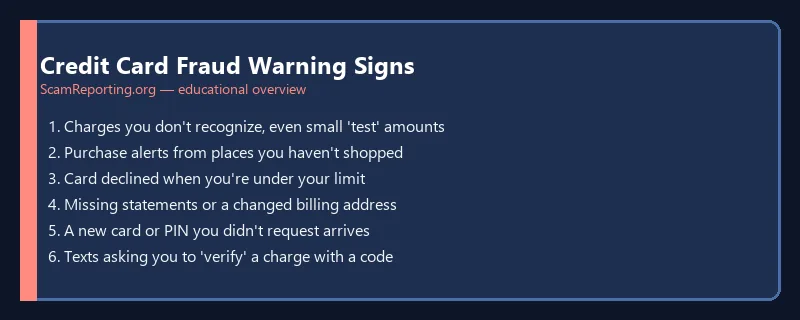
Credit Card Fraud Warning Signs
- Charges you do not recognize, even small “test” amounts
- Alerts for purchases in places you have not shopped
- A declined card when you know you are under your limit
- Missing statements or a changed billing address
- A new card or PIN you did not request arrives in the mail
- Calls or texts asking you to “verify” a charge by sharing a code
How to Report Fraud to Major Card Networks
Report to your issuing bank (the name on your statement), not just the network. If you cannot reach your bank, the networks — Visa, Mastercard, American Express, and Discover — publish customer fraud lines and route you to your issuer. Never call a number from a suspicious text; use the number on your card. Scam “fraud department” callbacks are a common trick — see phone impersonation red flags for the pattern.
Types of Credit Card Fraud
Reporting is similar across these, but knowing the type helps you explain what happened:
- Card-not-present fraud — your number is used online or by phone without the physical card. The most common type today.
- Lost or stolen card — someone uses your physical card. Report it stolen so the issuer can block it.
- Account takeover — a criminal gains access to your account, changes the contact details, and spends. Regain access and reset credentials immediately.
- New-account (application) fraud — a card is opened in your name with stolen identity data. This crosses into identity theft — see how to report identity theft.
- Skimming — a device copies your card at an ATM, gas pump, or terminal.
How Credit Card Numbers Get Stolen
Understanding the sources helps you avoid a repeat. Numbers are commonly stolen through data breaches at retailers, phishing emails and fake checkout pages, skimming devices on card readers, malware on your device, and social-engineering calls where a “fraud department” asks you to read a one-time code. Before you enter card details on a site you were sent to, check the message with the Scam Checker and the sender with Scammer Lookup. Legitimate banks never ask you to read them a verification code you received by text.
How to Protect Your Card After Reporting
- Use the new card number your issuer sends and update it on any legitimate recurring payments.
- Turn on transaction alerts so you are notified of every charge in real time.
- Use virtual card numbers or a mobile wallet for online purchases where possible.
- Review statements monthly — catching small test charges early prevents larger ones.
- Consider a credit freeze if you suspect your identity, not just one card, was exposed.
Debit Card Fraud: How It Differs
Reporting debit card fraud follows the same first step — call your bank immediately — but the stakes and rules differ. Debit fraud pulls real money from your checking account, and your protection depends on how fast you report: report before any unauthorized charge and your liability can be $0; within two business days it is capped at $50; wait longer and you can lose more. That is one reason many people prefer a credit card for online and travel purchases. If your debit card was hit, ask the bank to refund the account and issue a new card, and monitor for bounced payments while the balance is restored.
Common Mistakes When Reporting Credit Card Fraud
- Calling a number from a suspicious text. Always use the number on your card.
- Sharing a one-time code. Your bank will never ask you to read back a verification code.
- Waiting to see if charges “go away.” Report immediately to preserve your protections.
- Not getting confirmation in writing. Ask for written proof the charges were removed.
- Reusing the compromised number. Update recurring billing to the new card only.
If You Paid a Scammer With a Credit Card
Using a credit card for a scam purchase is actually the safest payment method for recovery, because you can dispute the charge (a chargeback). Contact your issuer, explain you were defrauded, and request a chargeback with evidence (order confirmations, messages, the seller’s site). For a broader view of recovery by payment method, see can you get money back after a scam. Report the seller on our report a scam form and check the sender with Scammer Lookup.
Frequently Asked Questions
How do I report credit card fraud?
Call your card issuer’s fraud line first to cancel the card and dispute charges, then report at ReportFraud.ftc.gov and file a police report if requested.
Am I liable for fraudulent credit card charges?
Federal law caps liability at $50, and most issuers offer $0 zero-liability protection for unauthorized charges you report promptly.
How long do I have to report credit card fraud?
Report as soon as you notice it. For billing-error disputes, you generally have 60 days from the statement date, but faster is always better.
Do I need a police report for credit card fraud?
Only when your issuer or a merchant requires one, your card was physically stolen, or the fraud is tied to identity theft.
Will reporting credit card fraud hurt my credit?
No. Reporting and disputing fraudulent charges does not lower your score; unresolved fraud is what can cause harm.
What if the charge was a scam purchase I approved?
You can still dispute it as a scam. Request a chargeback from your issuer with evidence you were deceived.
How do I report credit card fraud to the police?
File at your local police department in person or online, bringing your ID, a list of the fraudulent charges, and any FTC report number. Ask for a copy and the report number for your issuer.
What should I do if my card was skimmed at an ATM or gas pump?
Report the charges to your issuer, get a new card number, and note the location so the merchant and police can inspect the terminal for a skimming device.
Last reviewed: July 2026. ScamReporting.org is an independent educational resource — not a government agency, law enforcement, bank, credit bureau, or legal/financial advisor. For recovery or legal questions you may want to consult a licensed professional.