
What Is Advance-Fee Fraud?
Advance-fee fraud asks you to pay money before you receive a promised benefit — a loan, inheritance, donation, business partnership, or government refund. Scammers build trust with official-sounding emails, then request wire transfers, crypto, or banking details. This scheme is also called 419 fraud (named after the Nigerian criminal code section) and remains one of the oldest online scams.
Warning Signs
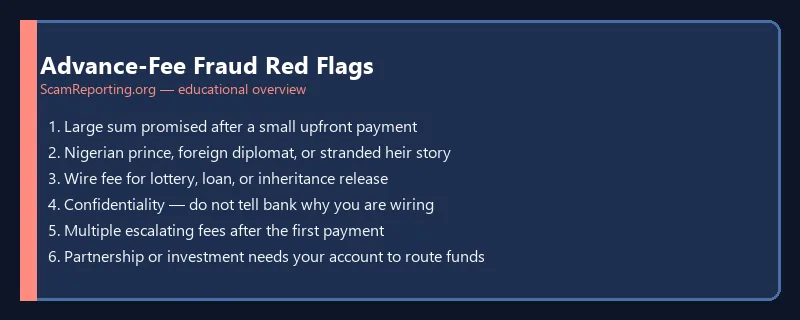
- Unsolicited contact from strangers offering money, jobs, or partnerships
- Upfront fees for processing, taxes, legal costs, or “release” of funds
- Secrecy requests — scammers tell you not to tell family or authorities
- Fake officials — impersonated bankers, UN representatives, or government agents
- Free webmail addresses (Gmail, Yahoo) instead of corporate domains
- Pressure and urgency to respond quickly
Common Variations
Advance-fee fraud appears in many forms. Read our dedicated guides for each pattern:
- Lottery & inheritance scam warning signs — dying benefactors, charity donations, prize claims
- Fake government refund scams — impersonated agencies promising compensation
- Employment scam warning signs — fake recruiters and upfront fees
- Business email compromise (BEC) — CEO fraud and wire-transfer scams
- Military romance scam red flags — peacekeepers asking for help moving money
Verified Scam Alert Reports
We have documented the following advance-fee and impersonation emails reported to ScamReporting.org:
Business & Bank Impersonation
- Good Partnership Deal For You — fake pharmaceutical partnership (Merck)
- Mr. Sochal Dith — FTB General Manager — foreign trade bank impersonation
- Contact PNC Bank Scam — fake Treasury / PNC transfer
- Write Back If You Are Interested — unsolicited business proposal
Lottery, Donation & Inheritance
- Donation of 1.5 Million
- Mrs. Jennette Godwi
- German €4.5M Donation Offer
- Mrs. Theresa Brown Donation
- Mark Cunning Ham Donation Offer
- Mrs. Ella Ellon Inheritance
- Mrs. Dorine Wood Donation
Government & Official Impersonation
Military Romance
What To Do
- Do not reply or send money, gift cards, or crypto
- Do not share banking details, passport copies, or ID scans
- Report the message on our Report a Scam page
- Forward phishing emails to your email provider’s abuse address
- If you already paid, see Get Help After a Scam
Frequently Asked Questions
Why do scammers ask for an upfront fee?
The fee is the entire point of the scam. There is no real loan, inheritance, or partnership — only your payment.
Is advance-fee fraud the same as a 419 scam?
Yes. “419 scam” is the common name for advance-fee fraud originating from West African email schemes, though it now operates globally.
Can a scammer keep contacting me after I refuse?
Yes. Block the sender, mark as spam, and do not engage. Replying confirms your email is active.
Should I report advance-fee emails to authorities?
Yes. Report to the FTC, your national cybercrime unit, and ScamReporting.org.
Was this guide helpful?
Your feedback helps us prioritize updates. We do not collect any personal data.
Thanks — recorded.