
Quick answer: To report a scammer to the FBI, file a complaint with the Internet Crime Complaint Center (IC3) at IC3.gov. IC3 is the FBI’s official channel for internet crime and fraud. Include the scammer’s details, a timeline, amounts lost, and transaction records. For a life-threatening emergency, call 911 instead.
Free checks: Scamil Email Checker · Scam Checker · Scammer Lookup
If you have been targeted by an online scam, learning how to report a scammer to the FBI puts the crime in front of federal investigators through IC3. The FBI does not take most fraud reports by phone — internet and financial fraud is routed through IC3.gov. This guide explains when the FBI is the right channel, exactly how to file an IC3 complaint, and what happens after you submit. Pair it with the broader how to report internet fraud guide, which covers the FTC and your bank.
Report to the FBI (official)
- FBI IC3 — ic3.gov (online complaint)
- FTC — ReportFraud — reportfraud.ftc.gov · 877-438-4338
- FBI tips — tips.fbi.gov
Official links open in a new tab. ScamReporting.org is an independent resource and is not affiliated with these agencies.
When to Report a Scammer to the FBI (IC3)
IC3 is the right channel for internet-enabled crime, including:
- Online scams where you lost money or personal information
- Business email compromise and wire-transfer fraud — see BEC red flags
- Investment and cryptocurrency fraud — see pig butchering scam signs
- Romance scams, extortion, and sextortion
- Ransomware, hacking, and data breaches affecting you
For non-internet consumer fraud, the FTC and your state attorney general may be a better fit. For identity theft specifically, start at IdentityTheft.gov — see how to report identity theft.
How to File an IC3 Complaint (Step by Step)
- Go to ic3.gov and choose to file a complaint.
- Provide your contact information so investigators can follow up.
- Describe the scam with a clear, chronological timeline of what happened.
- Add the scammer’s details — names, emails, phone numbers, usernames, websites, and crypto wallet addresses.
- List financial details — amounts, payment methods, bank names, and transaction or confirmation numbers.
- Attach or note evidence and submit. Save your IC3 complaint number.
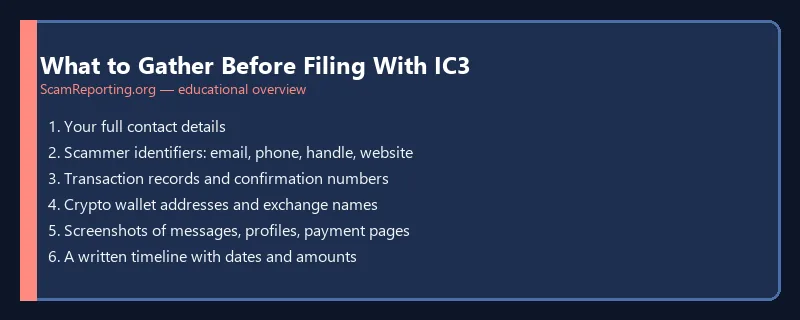
What Information to Gather Before Filing
- Your full contact details
- The scammer’s identifiers (email, phone, handle, website)
- Transaction records, receipts, and confirmation numbers
- Crypto wallet addresses and exchange names, if relevant
- Screenshots of messages, profiles, and payment pages
- A written timeline with dates and dollar amounts
What Happens After You File With IC3
IC3 reviews and analyzes complaints and refers them to the appropriate federal, state, or local law-enforcement agencies. You may not receive individual updates, and filing does not guarantee investigation or recovery of funds — but your complaint helps investigators connect victims and build cases. If you lost money, act in parallel: contact your bank immediately and report to the FTC. IC3 has a Recovery Asset Team that, in some fast-reported wire-fraud cases, can help freeze funds — which is why speed matters.
Common Scams IC3 Handles
IC3 accepts complaints across the full range of internet-enabled crime. The most reported categories include:
- Business email compromise (BEC) — fraudulent wire-transfer requests that impersonate executives or vendors.
- Investment and cryptocurrency fraud — fake trading platforms and “pig butchering” relationship-investment scams.
- Confidence and romance fraud — long-cons that build a relationship before asking for money.
- Tech-support fraud — fake alerts and callers demanding remote access or payment.
- Personal data breach and account takeover — stolen credentials used to drain accounts.
- Extortion and sextortion — threats to release information unless paid.
How to Strengthen Your IC3 Complaint
The more precise your complaint, the more useful it is to investigators. Write your timeline in plain, chronological order; paste exact email addresses, phone numbers, and URLs rather than paraphrasing; include every transaction with its date, amount, method, and reference number; and add crypto wallet addresses and exchange names when relevant. If the fraud is ongoing, note that clearly — time-sensitive wire fraud can sometimes be interrupted. Keep your own copy of everything you submit, plus the IC3 complaint number you receive.
Other FBI and Federal Reporting Options
IC3 is the main channel for internet crime, but a few others may apply. You can submit general tips to the FBI at tips.fbi.gov, report identity theft at IdentityTheft.gov (see how to report identity theft), and report consumer fraud to the FTC. For scams targeting older adults, the DOJ’s National Elder Fraud Hotline can help you navigate reporting. Choose the channel that matches your situation, and it is fine — often best — to report to more than one.
Keep a Record After You File
After submitting your IC3 complaint, save the confirmation and complaint number, and keep a folder with every screenshot, email, receipt, and bank communication related to the scam. You may need this record when your bank investigates a dispute, when an insurer or employer asks for proof, or if law enforcement follows up months later. If new information surfaces — a fresh message from the scammer, a new wallet address, or another victim you know — you can submit an additional IC3 complaint referencing your original number. Good records also make it easier to report the same scammer to the FTC and your state attorney general without starting from scratch.
FBI Impersonation: Don’t Get Scammed Twice
Scammers sometimes pose as the FBI or IC3 to target people who already lost money, promising to “recover” funds for a fee. The FBI does not call demanding payment, gift cards, or crypto, and legitimate agencies never charge to recover money. Learn the pattern in our recovery room scam guide, and verify suspicious callers with Scammer Lookup.
IC3 vs. Local Police: Which Should You Use?
Use both when it makes sense. IC3 is built for internet-enabled crime and routes complaints to the right federal or local investigators, but it does not replace a local police report. File a police report when a creditor or bank requires one, when there is a physical element (stolen mail, a break-in, a local suspect), or when you need a case number for insurance or identity-theft recovery. For pure online fraud with an unknown, out-of-state, or overseas scammer, IC3 plus the FTC is usually the most effective combination. Local departments have limited ability to pursue anonymous cross-border internet fraud, which is exactly what IC3 is designed to aggregate.
What IC3 Can and Cannot Do
It helps to have realistic expectations. IC3 can collect and analyze your complaint, connect it with related reports, refer it to law enforcement, and — through its Recovery Asset Team — sometimes help freeze fraudulent domestic wire transfers if reported quickly. IC3 cannot guarantee an investigation of your specific case, act as your personal case manager, or recover funds sent by irreversible methods like gift cards or crypto in most situations. That is why you should always pair an IC3 filing with immediate action at your bank and, where relevant, the steps in can you get money back after a scam.
Reporting to the FBI vs. the FTC
| Channel | Best for | Website |
|---|---|---|
| FBI IC3 | Internet crime, wire fraud, crypto, BEC | ic3.gov |
| FTC | Consumer fraud reports & trend tracking | ReportFraud.ftc.gov |
| IdentityTheft.gov | Identity theft recovery plan | identitytheft.gov |
Reporting to both the FBI and the FTC is recommended for most online scams.
Frequently Asked Questions
How do I report a scammer to the FBI?
File an internet crime complaint at IC3.gov with the scammer’s details, a timeline, amounts lost, and transaction records.
Can I report a scammer to the FBI by phone?
Most internet fraud is reported online through IC3.gov, not by phone. Call 911 only for an immediate emergency.
Is reporting to IC3 free?
Yes. IC3 is a free FBI service. Anyone who charges you to file is a scam.
Will the FBI investigate my complaint?
IC3 analyzes complaints and refers them to law enforcement. Not every report leads to an individual investigation, but each one adds valuable evidence.
How long does IC3 take to respond?
You may not get a personal response. Keep your complaint number and continue working with your bank and the FTC.
What if a caller claims to be the FBI recovering my money?
It is a scam. The FBI does not call to collect fees or recover funds for a price. Hang up and report it.
Do I need to know the scammer’s real identity to file?
No. Report whatever identifiers you have — email, phone, username, website, or wallet address. Investigators piece identities together across many complaints.
Should I file with IC3 and my local police?
Often yes. Use IC3 for the internet crime and a local police report when a bank, creditor, or insurer requires a case number or there is a physical or local element.
Can I report a scammer to the FBI on behalf of a relative?
Yes. Gather the evidence together and file in their name with their consent. For older adults, the DOJ National Elder Fraud Hotline can also help.
What is the IC3 Recovery Asset Team?
It is an FBI team that, in fast-reported domestic wire-fraud cases, works with banks to freeze fraudulent transfers. Speed is critical — report the same day you discover the fraud for the best chance.
Last reviewed: July 2026. ScamReporting.org is an independent educational resource — not a government agency, law enforcement, bank, credit bureau, or legal/financial advisor. For recovery or legal questions you may want to consult a licensed professional.