
Quick answer: To report internet fraud, file a complaint with the FBI’s Internet Crime Complaint Center at IC3.gov and report to the FTC at ReportFraud.ftc.gov. If you lost money, also contact your bank or card issuer immediately, and report the fraud to the platform where it happened.
Free checks: Scamil Email Checker · Scam Checker · Scammer Lookup
Knowing how to report internet fraud gets the crime on record with the right agencies and improves the odds of disrupting the scammer. Online scams — from phishing and fake shops to investment and romance fraud — are reported through a handful of official channels. This guide explains where to report an online scam, what information to gather first, and how to protect yourself afterward. Before you engage with a suspicious message, paste it into our Scam Checker or verify a sender with Scammer Lookup.
Where to report internet fraud (official)
- FTC — ReportFraud — reportfraud.ftc.gov · 877-438-4338
- FBI IC3 — ic3.gov (online complaint)
- Cross-border (eConsumer) — econsumer.gov
Official links open in a new tab. ScamReporting.org is an independent resource and is not affiliated with these agencies.
Where to Report Internet Fraud
Report to more than one place — each agency serves a different purpose:
- FBI IC3 (ic3.gov): the central hub for internet crime complaints in the United States. See our dedicated how to report a scammer to the FBI guide.
- FTC (ReportFraud.ftc.gov): feeds law-enforcement databases and tracks scam trends.
- Your bank or card issuer: the fastest route to stop or reverse a payment.
- The platform: the marketplace, social network, email provider, or app where the fraud occurred.
- Your state attorney general: for consumer-protection action in your state.
Step-by-Step: How to Report an Online Scam
- Stop contact with the scammer and do not send more money.
- Preserve evidence — screenshots, URLs, usernames, emails, transaction IDs, and wallet addresses.
- Contact your bank or payment provider if money was sent, and ask about reversing or disputing it.
- File with IC3 at ic3.gov with your evidence and a clear timeline.
- Report to the FTC at ReportFraud.ftc.gov.
- Report to the platform and your state attorney general.
- File on ScamReporting.org using our report a scam form so the tactic is documented.
Types of Internet Fraud (and Where to Report Each)
- Phishing & smishing — fake emails or texts harvesting logins. Forward phishing emails to your provider and report to the FTC.
- Online shopping & fake stores — report the seller, dispute the charge, and see how to report a scam website.
- Investment & crypto fraud — report to IC3 and the SEC/CFTC; see pig butchering scam signs.
- Romance scams — report to IC3, the platform, and see romance scam red flags.
- Business email compromise — report to IC3 fast; see BEC red flags.
- Tech-support fraud — report to the FTC and the software brand being impersonated.
What Information to Include in Your Report
Complete reports are more actionable. Gather:
- Dates and a timeline of what happened
- The scammer’s email addresses, phone numbers, usernames, and website URLs
- Amounts lost and payment methods (card, wire, Zelle, crypto, gift card)
- Transaction IDs, confirmation numbers, and crypto wallet addresses
- Screenshots of messages, listings, and payment receipts
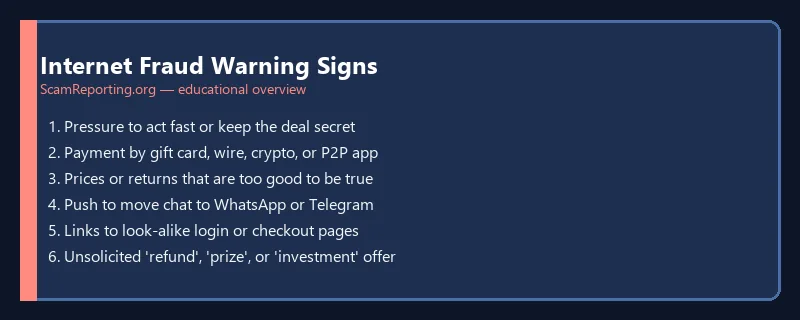
Internet Fraud Warning Signs
- Pressure to act fast or keep the deal secret
- Payment demanded by gift card, wire, crypto, or peer-to-peer app
- Prices or returns that are far too good to be true
- Requests to move the conversation to WhatsApp, Telegram, or text
- Links to look-alike login pages or unfamiliar checkout sites
- An unsolicited “refund,” “prize,” or “investment” opportunity
How Online Scams Typically Unfold
Most internet fraud follows a recognizable arc, and spotting the stage you are in helps you stop before you lose more:
- Contact. An ad, email, text, DM, or marketplace listing reaches you — often unsolicited.
- Trust-building. The scammer seems professional, friendly, or authoritative, and may show fake reviews, credentials, or small “wins.”
- The hook. A deal, romance, job, refund, or investment creates a reason to act.
- Urgency and isolation. You are pushed to decide fast and to keep it private or move to a messaging app.
- Payment. Funds are requested by an irreversible method — gift card, wire, crypto, or peer-to-peer app.
- Re-targeting. Anyone who pays is marked as responsive and pitched again, sometimes by a fake “recovery” service.
Reporting at any stage helps — even a near-miss report adds to the intelligence that agencies and platforms use to shut scams down.
Reporting Fraud on Specific Platforms
Platform reports rarely recover money on their own, but they help remove scammers and should be filed alongside IC3 and the FTC:
- Marketplaces (Facebook Marketplace, Craigslist, eBay): use the in-app “report” option on the listing or seller.
- Social media (Instagram, Facebook, X, TikTok): report the profile and message, then block.
- Email (Gmail, Outlook): use “report phishing” so the provider trains its filters.
- Payment apps (Zelle, Venmo, Cash App, PayPal): report the transaction in-app — see Venmo and Cash App scam warning signs.
- Crypto exchanges: report the wallet or account; include addresses in your IC3 complaint.
Who Internet Scammers Target
Anyone can be targeted, but fraud rings tailor scripts to specific groups: job seekers get fake-recruiter offers, older adults get tech-support and grandparent scams, investors get crypto and “pig butchering” pitches, and small businesses get invoice and email-compromise fraud. Understanding that these are organized, scripted operations — not one-off bad luck — makes it easier to report without shame and to warn others.
If You Already Lost Money to Internet Fraud
Move quickly. Contact your bank or card issuer to dispute or recall the payment, change passwords on affected accounts, and freeze your credit if personal data was exposed — see how to freeze your credit. For realistic recovery odds by payment method, read can you get money back after a scam, and beware follow-up recovery room scams that target people who already lost money.
Should You Report Even a Small Loss or a Near-Miss?
Yes. Many people skip reporting because the amount was small or because they caught the scam in time — but every report matters. Agencies and platforms rely on volume to spot patterns, link victims to the same offenders, and prioritize takedowns. A near-miss report can protect the next person who receives the same message. Reporting also creates a paper trail you may need later for a bank dispute, an insurance claim, or a tax deduction on a fraud loss. There is no minimum threshold to file with the FTC or IC3.
Reporting Internet Fraud for Someone Else
You can help a family member or friend report fraud, especially older relatives who may be embarrassed or overwhelmed. Sit with them, gather the evidence together, and file the reports in their name with their consent. For scams targeting seniors, the U.S. Department of Justice runs a National Elder Fraud Hotline that can guide you through the right agencies. Approach the conversation without blame — shame keeps victims silent and lets scammers keep operating.
How to Avoid Internet Fraud
Use unique passwords and two-factor authentication, keep software updated, and never enter credentials on a page you reached from a link. Verify sellers and senders before you pay, and treat any unexpected request for gift cards, wire transfers, or crypto as a red flag. When in doubt, check the message with the Scam Checker or the Scamil Email Checker first, and browse the scam types hub to learn the current playbooks.
Frequently Asked Questions
Where do I report internet fraud?
File with the FBI’s IC3 at ic3.gov and the FTC at ReportFraud.ftc.gov, and contact your bank if money was lost. Report to the platform where the scam occurred too.
Is reporting internet fraud free?
Yes. IC3 and the FTC are free government reporting channels.
What is the difference between the FTC and IC3?
The FTC collects consumer fraud reports and tracks trends; IC3 is the FBI’s complaint center for internet crime that can support investigations. Reporting to both is recommended.
Can I report internet fraud anonymously?
Reports are most useful with your contact details so investigators can follow up, but you control what personal information you share.
Will reporting get my money back?
Reporting does not guarantee recovery, but fast reporting to your bank plus IC3 and the FTC gives you the best chance and helps stop the scammer.
What if the fraud happened on a social platform?
Report it in-app to the platform and also file with IC3 and the FTC, since platform action alone rarely recovers funds.
Should I report a scam if I did not lose any money?
Yes. Near-miss and attempt reports help agencies spot patterns and protect others. There is no minimum loss to file with the FTC or IC3.
How do I report an international online scam?
File with IC3, which handles cross-border internet crime, and the FTC. You can also report to eConsumer.gov for scams involving foreign companies.
How long should I keep my fraud records after reporting?
Keep screenshots, receipts, and report numbers for at least a year — longer if a bank dispute, insurance claim, or tax loss is involved. They support follow-up and any future investigation.
Last reviewed: July 2026. ScamReporting.org is an independent educational resource — not a government agency, law enforcement, bank, credit bureau, or legal/financial advisor. For recovery or legal questions you may want to consult a licensed professional.