
Quick answer: A utility shutoff scam is a phone call, text, or email claiming your electric, gas, or water service will be disconnected within hours unless you pay immediately — often by gift card, wire transfer, cryptocurrency, or a mobile payment app. Real utilities send written notices and do not demand untraceable payment on a cold call.
July 2026 update: Our editors refreshed this guide based on recent FTC advisories and reader reports. See the latest alerts and weekly digest.
Check before you pay: Scamil Email Checker · Scam Checker · Scammer Lookup · Phone Scam Checker · Payment Scam Checker · All tools
Summer heat waves and winter cold snaps push scammers to impersonate power companies and gas utilities. The utility shutoff scam preys on fear: you are told a crew is already en route, your account is past due, or a meter reading failed. This guide explains how shutoff impersonation works, the red flags that expose fake utility agents, and what to do before you send money or share account numbers.
How Real Utilities Handle Shutoff Notices
Legitimate electric, gas, and water providers in the United States follow predictable rules. They typically:
- Mail multiple past-due notices before any disconnection
- Post a door hanger or final notice at the service address
- Offer payment plans and hardship programs through official billing departments
- Accept standard payment methods — online portal, auto-pay, check, or card through verified channels
- Provide a customer service number printed on your bill, not only on caller ID
They do not demand gift cards, Bitcoin, Zelle, or Cash App to stop a same-day shutoff. They do not threaten arrest, deportation, or IRS action over a residential bill. If a caller insists you stay on the line while you buy prepaid cards, hang up — that is a gift card payment scam pattern used across many impersonation schemes.
Common Utility Shutoff Scam Scripts
Same-day disconnection threat
A robocall or live agent says power will be cut within 30–60 minutes unless you pay a “reconnection fee” immediately. Spoofed caller ID may show your utility’s name or a local exchange. The scammer routes you to a fake billing line that sounds professional.
Faulty meter or “smart meter” upgrade
You hear your meter failed inspection and service must be suspended unless you verify identity and pay a deposit. Real meter work is scheduled in advance and documented on your account portal.
Overpayment refund trick
A caller claims you overpaid and need to return the excess by wire before the account unlocks — a variant of the Zelle refund scam adapted for utilities.
Text and email shutoff links
Smishing messages include a link to “pay now” on a look-alike site. See smishing examples and paste suspicious text into the Scam Checker before you tap links.
How a Utility Shutoff Scam Works (Step by Step)
- Spoofed contact — call, text, or email appears to be from Duke Energy, PG&E, Con Edison, or your regional provider.
- Urgency — disconnection today, a truck is nearby, or your medical equipment will lose power.
- Payment push — gift cards, wire, crypto, or payment apps that cannot be reversed.
- Account harvest — login credentials, Social Security number, or card details for “verification.”
- Repeat targeting — paid victims are marked as responsive and called again.
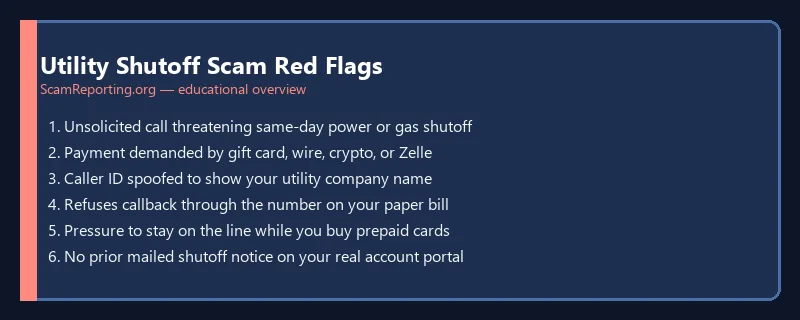
Utility Shutoff Scam Red Flags
- First contact is a phone call or text — not a mailed bill or portal alert you already use
- Payment must be completed while still on the phone
- Caller refuses to give a callback number that matches your paper bill
- Instructions to buy Visa or Apple gift cards and read numbers aloud
- Threats involving police, ICE, or license suspension unrelated to utility service
- Requests for remote access to your computer to “process payment”
- Email sender domain is Gmail, Yahoo, or a misspelled utility URL
- Offer to send a “technician” only after you pay a cash fee in person
What to Do If You Get a Shutoff Threat
- Hang up. Do not press menu options on robocalls — that confirms a live number.
- Call your utility using the number on your last statement or the official website you type yourself.
- Sign in to your real online account — check balance and notices there, not through links in messages.
- Report to the FTC at ReportFraud.ftc.gov and your state attorney general.
- Warn neighbors — shutoff scams often hit entire ZIP codes during heat waves.
- File on ScamReporting.org via our report a scam form so others see the script.
If You Already Paid a Scammer
Contact your bank or card issuer immediately using the number on your card. Gift card payments are difficult to recover — see get help after a scam for realistic next steps. If you shared login or identity data, follow our SSN exposure checklist.
Summer vs. Winter Peak Seasons (2026)
Scammers time campaigns to weather stress. Summer spikes follow heat advisories; winter spikes follow cold snaps and heating fuel price news. Our summer utility shutoff alert tracks the latest wave. Legitimate hardship programs exist — apply only through your utility’s verified website or mailed forms.
Who Is Most Targeted by Shutoff Scams?
Anyone with a utility account can receive these calls, but scammers focus on groups more likely to panic-pay:
- Seniors and caregivers — especially when medical equipment requires uninterrupted power
- Renters — who may not know whether the landlord or tenant pays the bill
- Small businesses — where a same-day “commercial disconnect” threatens inventory loss
- New movers — who have not yet set up autopay and lack billing history
- Non-English speakers — pressured with fast speech and legal-sounding threats
If you manage bills for a parent or client, agree in advance on a verification step: hang up and call the number on the paper bill together before any payment.
Verify Your Utility Without Using Caller ID
- Find your last paper bill or envelope — note the customer service number printed there.
- Open a browser and type your utility’s domain yourself (for example, your state’s major electric or gas provider).
- Log in to the official portal and review balance, due date, and shutoff notices.
- If you have no online account, call the printed number and ask whether a disconnect order exists on your address.
- Ask the representative to read the last four digits of the account number they have on file — compare to your bill.
Never call back a number left on voicemail unless it matches your bill. Scammers operate callback centers that answer with fake hold music and scripted “account lookup.”
Business and Commercial Shutoff Variants
Restaurant, retail, and warehouse owners report calls claiming a commercial meter will be locked unless a same-day wire is sent. The script adds fines for “after-hours reconnection.” Real utilities bill commercial accounts through established AR contacts and rarely demand gift cards. Train staff who answer the main line: no payments over the phone without supervisor verification through the known vendor portal.
Texts, Emails, and QR Codes on Fake Bills
Some campaigns send PDF attachments that mimic a shutoff notice with a QR code for “instant payment.” QR codes can route to phishing wallets — see our QR code phishing guide. Forward suspicious utility emails through the Scamil Email Checker before you open attachments or scan codes.
How Utility Shutoff Scams Differ From Other Impersonation Calls
| Scheme | Hook | Payment method |
|---|---|---|
| Utility shutoff scam | Power or gas off today | Gift cards, wire, crypto |
| IRS phone scam | Back taxes, arrest warrant | Wire, gift cards |
| Medicare scam call | Benefits ending | “Activation” fee |
| Amazon impersonation text | Account lock | Phishing link |
Browse the scam types hub for related government and brand impersonation guides.
Frequently Asked Questions
Will my utility ever call about shutoff?
Some utilities make courtesy calls, but they do not demand gift cards or immediate wire transfers. When unsure, hang up and call the number on your bill.
Can caller ID show my power company’s real name?
Yes — scammers spoof legitimate names and numbers. Caller ID is not proof of identity.
What if they know my account balance?
Partial data may come from public records or prior breaches. Knowing your name or address does not prove the call is real.
Should I let a “technician” into my home?
Only after you schedule service through official channels. Scammers rarely send real technicians — they want remote payment.
How do I report a fake utility website?
Report to the FTC, your state AG, and the FBI’s IC3 at ic3.gov. See also how to report a scam to the FTC.
Are door-to-door utility impostors common?
Yes in some regions. Ask for company ID, call the utility verification line, and never pay cash on the spot for “reconnection.”
Can my landlord shut off power through a third-party caller?
Residential shutoff rules vary by state and tenant protections. A random caller cannot authorize disconnect on your landlord’s behalf. Verify with the utility using your service address.
What if I am on a medical baseline or critical care list?
Many states offer medical baseline programs with extra notice before disconnect. Enrollment is through the official utility — not a phone agent who calls uninvited.
Last reviewed: July 2026.
Report impersonation: How to report a scam on HowToReport.org · consumer fraud reporting for utility billing disputes.